










Complete guide: how to make a success of your industrial MES project ?

In an industrial environment where performance, traceability and responsiveness have become essential, the Manufacturing Execution System (MES) occupies a central position. Well-designed and well-integrated, it connects operations, improves data quality, makes processes more reliable, and continuously optimizes the management of production units.
But deploying an MES is more than just installing software: it’s a structuring project, at the crossroads of processes, IT, operational management and data.
For over 20 years, Technord has been supporting industrial companies in Belgium, France and abroad in their MES projects, from design to implementation, including integration with ERP, SCADA systems, PLCs and IoT.
In this guide, our teams give you the keys to a successful MES project, with concrete feedback and a reliable methodology adapted to complex industrial environments.
An MES project: first and foremost, an industrial transformation.
The implementation of an MES aims to make the factory more predictable, more connected and more efficient. The system doesn’t just add a digital layer: it structures information flows, makes the execution of manufacturing orders more reliable, consolidates performance indicators and reinforces traceability at every stage.
The value of an MES is measured in the quality of the data produced, the stability it brings to processes, the enhanced reliability of planning and the ability of teams to rely on a unified, coherent vision of production.
The most common errors in MES projects.
Experience shows that the difficulties encountered in MES projects rarely stem from the software chosen. Rather, they stem from insufficient scoping or a partial understanding of interactions within the industrial ecosystem.
+ Choosing a solution before defining actual needs
Experience shows that the difficulties encountered in MES projects rarely stem from the software chosen. Rather, they stem from insufficient scoping or a partial understanding of interactions within the industrial ecosystem.
+ Underestimating the complexity of flows and interactions
An MES operates at the heart of the value chain: internal logistics, OF management, machine operations, quality, coordination between workshops. Neglecting this complexity results in a blurred perimeter and objectives that are difficult to achieve.
+ Neglecting integration with the existing environment
An MES derives its value from its ability to communicate with ERP, SCADA, PLCs and IoT sensors. Without careful consideration of integration, it becomes an additional silo instead of a central system.
+ Deploy too wide, too fast
Brownfield environments require a progressive approach. A well-constructed pilot validates workflows, secures integration and prepares teams for wider deployment.
+ Underestimating the human dimension
MES changes daily practices.Support for operators, supervisors and quality teams is essential to ensure smooth, lasting adoption.
Key steps to a successful MES project
Technord applies a structured methodology designed to control complexity, secure IT/OT integrations and guarantee robust deployment.
blank
Step 1: Audit and scoping: getting a clear picture of what exists
Each project begins with a detailed analysis of processes, internal flows, friction points and existing systems. This phase enables us to identify performance levers, assess IT/OT constraints and define the exact role of MES in your industrial architecture.
It serves as a solid basis for designing a solution consistent with your strategic priorities.
Step 2: Performance-oriented specifications
The specifications must express operational expectations, not an accumulation of functionalities.
Performance objectives (OEE, scrap, machine availability, planning reliability, traceability, quality, energy efficiency) structure the project and guide functional and technical choices.
Stage 3: an interoperable, scalable and secure MES architecture
Integration is the key to success. A high-performance MES must communicate with the ERP, interact with SCADA systems, exchange data in real time with PLCs, collect data from sensors and feed analytical platforms.
This interoperability is based on dual IT/OT expertise, which is essential in often heterogeneous environments.
The cybersecurity dimension is integrated right from the design stage to guarantee availability, data protection and operational continuity.
Stage 4: gradual implementation (pilot, adjustments, deployment)
Step-by-step deployment reduces operational risks. The pilot allows us to observe flows in real-life conditions, adjust ergonomics and validate interactions with existing systems.
Once the pilot has stabilized, extension to other lines or other sites is carried out gradually and in a controlled manner, an approach perfectly suited to multi-site projects.
Step 5: Rigorous validation before going live
Before commissioning, Technord carries out extensive tests, based on the requirements of regulated sectors.
This validation ensures that the solution is reliable, stable and perfectly adapted to the real production environment.
Step 6: long-term support for adoption
The success of an MES depends on team commitment. The first few weeks are essential for adjusting interfaces, stabilizing flows, answering questions and consolidating usage.
Once up and running, MES becomes a structuring tool forcontinuous improvement, energy performance, quality and advanced data analysis.
What ROI can you expect from an MES project
The returns observed show significant gains: a more stable OEE, a reduction in scrap, more reliable planning, better internal coordination, fewer operator errors and a measurable impact on energy consumption.
In most cases, the return on investment is between 12 and 24 months.
Case study: digitizing production workflows
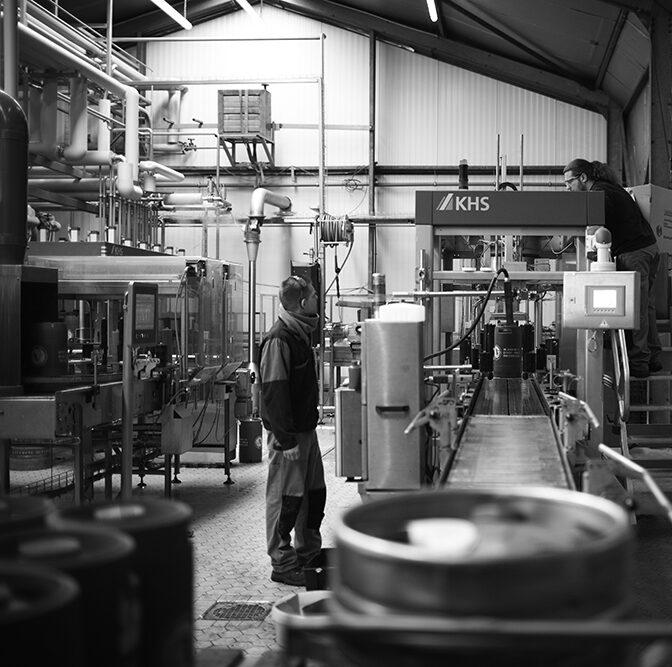
A manufacturer wanted to harmonize its management tools, streamline exchanges between departments and reinforce traceability.
Technord designed an architecture combining a modular MES, ERP / MES / SCADA integration, digitized operating flows and real-time supervision.
This approach has reduced errors, improved coordination and provided a consolidated view ofoperations, laying a solid foundation for future optimization.
Why choose Technord for your MES project?
Technord combines several key assets:
- Total technological independence;
- Dual IT/OT expertise, essential for integrating complex environments;
- Complete mastery of MES-ERP-SCADA-PLC-IoT integrations ;
- Extensive experience of brownfield and multisite projects;
- Over twenty years’ experience in MES and specialized teams.
An MES project is a structuring lever for industrial performance. By combining a precise analysis of the field, a robust architecture, progressive implementation and long-term support, it is possible to transform operations over the long term and boost plant competitiveness.
Talk about your MES project with a Technord specialist
Contact us >